

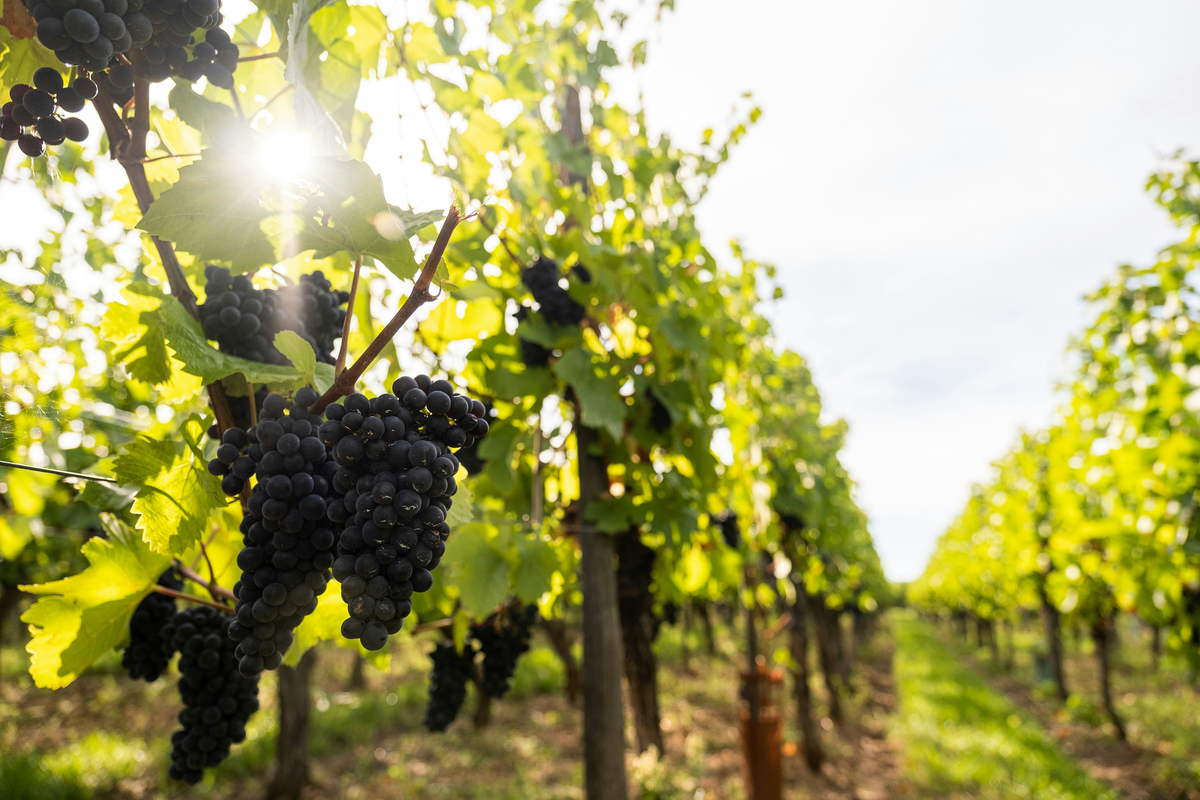
Translated, Blanc de Noirs means “white from blacks”, a name that captures exactly what makes this style so interesting. It’s a Champagne made entirely from red grapes, most commonly Pinot Noir, Pinot Meunier, or a mix of the two.
The result may be white, but it all starts with red grapes. The secret lies underneath the skin.
Why red grapes can produce white Champagne
Pinot Noir and Pinot Meunier may have dark, coloured skins, but the juice inside the grapes is essentially colourless. The colour we associate with red wine comes primarily from the skins, not the juice itself.
Limit the juice’s contact with those skins, and red grapes can produce a remarkably pale wine.
For Blanc de Noirs, this starts almost immediately after the grapes are harvested.
From red grapes to white juice
The grapes are pressed gently, allowing the juice to be separated from the coloured skins before it picks up significant colour.
It sounds simple, but it is a delicate part of the process. The aim is to extract the juice while leaving the colour of the skins behind.
The result is one of Champagne’s more surprising transformations: a white Champagne made entirely from red grapes.
And while the colour may disappear, the character of those grapes certainly doesn’t.
What Pinot Noir and Meunier bring to the glass
It shows in the glass too. Set a Blanc de Noirs next to a Blanc de Blancs, and the Blanc de Noirs is usually the fuller, more structured of the two, with more weight behind it.
You can often find red fruit, brioche and a richer, more generous finish, compared with the typically fresher, lighter profile associated with Blanc de Blancs.
In other words, the name tells you which grapes are behind the Champagne, but it also hints at what’s waiting for you in the glass.
A Champagne made for the table
That fuller structure is also what makes Blanc de Noirs such a natural Champagne for the table.
Where a lighter Champagne can easily play the role of an aperitif, the fuller structure of a Blanc de Noirs allows it to stand up to richer dishes. Charcuterie, roasted meats and rich pasta dishes are all natural places to start.
It is a useful reminder that Champagne doesn’t have to come before dinner. The right bottle can sit comfortably alongside it.
So the next time you see Blanc de Noirs on a label, remember: the colour may stay behind in the skins, but the character of Pinot Noir and Meunier makes it all the way into the glass.